

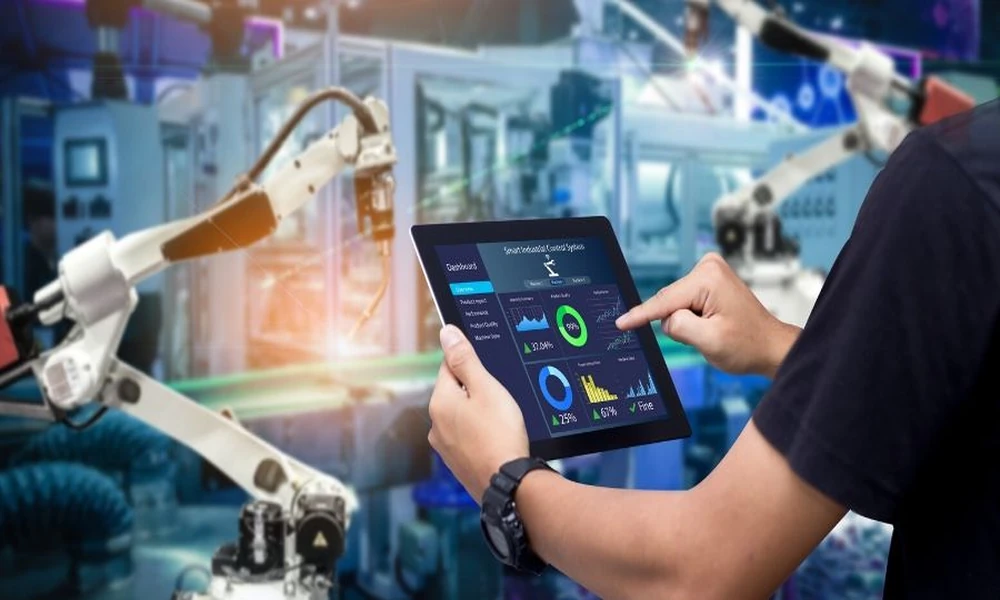
Walk onto almost any production floor today and you’ll notice something has shifted. The clipboards are gone. The whiteboards tracking downtime have been replaced by dashboards. And increasingly, the machines are talking to each other before anyone needs to ask what’s wrong.
This is the quiet reality of digital manufacturing: not a single dramatic overhaul, but a steady accumulation of smarter tools, tighter feedback loops, and decisions that get made in seconds instead of shifts.
From Reactive to Predictive
For decades, shop floor management ran on a reactive model. A machine broke down, someone noticed, a technician got called, and production stopped until the fix was in place. It worked, but it was expensive in ways that were hard to see until you added them up – lost cycles, rushed repairs, and schedules thrown into chaos.
Predictive maintenance flips that script. Sensors embedded in equipment track vibration, temperature, and load in real time, feeding that data into systems that flag anomalies before they become failures. A bearing that’s starting to wear shows a subtle change in vibration pattern weeks before it would actually seize. Catching that early means the difference between a five-minute part swap during scheduled downtime and an eight-hour emergency shutdown.
This shift matters because unplanned downtime remains one of the biggest silent costs in manufacturing. Plant managers who once budgeted for it as an unavoidable line item are now treating it as a solvable problem.
Data as the New Shop Floor Currency
The second major change is how information moves. Traditional production lines generated data, but it stayed trapped – in a PLC log here, a paper travel sheet there, an operator’s mental notes somewhere else. Manufacturing execution systems (MES) now unify that data into a single, queryable layer.
The practical effect is significant. A production manager can see, in real time, which line is running below takt time, which shift produced the most scrap, and why. That last part – the why – is what separates modern systems from older tracking tools. Root-cause analysis that used to take a week of digging through logs now happens through a filtered report.
This also changes how engineers approach process improvement. Instead of relying on periodic audits, teams can run continuous process optimization, adjusting parameters based on live performance rather than quarterly reviews.
The Rise of Collaborative Automation
Perhaps the most visible shift on the floor itself is the growing presence of collaborative robots, or cobots. Unlike traditional industrial robots, which operate behind safety cages and require extensive programming expertise, cobots are designed to work alongside human operators, adapting to smaller batch sizes and more frequent changeovers.
This matters enormously for mid-sized manufacturers who previously found full automation financially out of reach. A cobot arm handling repetitive tasks – palletizing, screw driving, quality inspection – frees up skilled operators for higher-value work, without the capital expense or facility redesign that full robotic cells demand.
Flexibility is the operative word here. Automation providers such as Onrobot cobotics have built their offering specifically around modular end-effectors that can be reconfigured for different tasks in minutes rather than days, which fits naturally into production environments where product mix changes constantly and long changeover times simply aren’t affordable.
Digital Twins and the Shift Toward Simulation
Before committing capital to a new line configuration, engineers increasingly rely on digital twins – virtual replicas of physical assets or entire production systems. These models let teams simulate throughput changes, test new layouts, and stress-test scheduling logic without touching the actual floor.
The value isn’t theoretical. A layout change that looks efficient on paper might create a bottleneck at a specific workstation once real cycle times and material flow are factored in. Running that scenario in a digital twin first avoids costly trial-and-error on the actual line, where every hour of disruption has a direct cost.
What This Means for the People on the Floor
None of this replaces the expertise of engineers and operators – it redirects it. Where a technician once spent hours manually logging machine states, that time now goes toward interpreting trends and making calls that actually require judgment. Where a production manager once relied on gut instinct shaped by years of experience, that instinct is now backed by data that confirms or challenges it in real time.
The manufacturers seeing the biggest gains aren’t necessarily those with the most advanced technology stack. They’re the ones who’ve integrated these tools into daily decision-making rather than treating them as a separate reporting layer bolted onto existing habits.
Looking Ahead
Digital manufacturing isn’t a single destination – it’s an ongoing recalibration of how information, machines, and people interact on the floor. Predictive maintenance reduces surprises. Unified data systems turn scattered numbers into actionable insight. Cobots extend automation to tasks and teams that couldn’t access it before. Digital twins de-risk decisions before they’re made physical.
For engineers and plant managers navigating this shift, the practical question isn’t whether to adopt these tools, but which combination fits the specific rhythm of their operation – because the shop floor that adapts fastest to this new toolkit is usually the one that ends up setting the pace for everyone else.
